


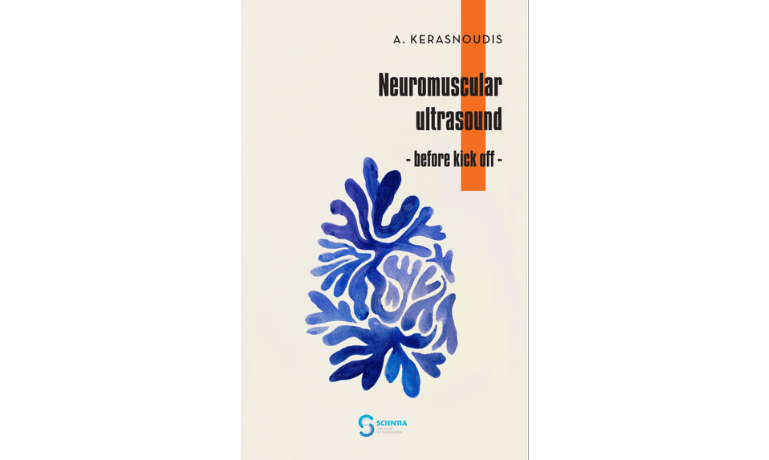
Neuromuscular Ultrasound -before kick off-

- Description
- Curriculum
- Notice
View e-book contents
Antonis Kerasnoudis is Assistant Professor of Neurology at Ruhr University in Bochum, Germany, while during the last decade he runs a private practice in Serres, Greece. He is also the Head of the Multiple Sclerosis and Neurosonology clinics at the Saint Luke Hospital in Thessaloniki, Greece.
He has many years of international teaching experience in the field of Neurosonology, having organized teaching seminars for both the European Society of Neurophysiology (ICCN) and the Hellenic Society of Clinical Neurophysiology, as well as for educational institutions in Germany (Plato Academy Bonn) and the UAE (IBC Medical Services). He has been the Editor of the teaching textbook on Neurosonology of the Hellenic Society of Clinical Neurophysiology, has published a significant series of original research articles in reputable scientific journals, and has been awarded for his scientific work (Young Investigator Award) by the European Society of Neurophysiology (ICCN).

This e-book consists of 16 chapters organized in 3 sections
In the first, introductory section, following a brief overview of the history of ultrasound, the reader is guided through the fundamental principles of ultrasound physics, device settings and image optimization in medical ultrasonography. Furthermore, the normal sonographic appearance and echogenicity of nerves, muscles, tendons and bones are presented in a clear and concise manner.
Through these chapters, physicians will gain a solid understanding of the physical principles underlying ultrasound image acquisition, learn how to correctly acquire and optimize high-quality ultrasound images, and develop the ability to recognize common artifacts and potential diagnostic pitfalls.
In the second section, the detailed anatomical course and sonography correlation of the most clinically significant peripheral nerves of the upper extremity are presented. Among the nerve structures discussed , readers will also find a comprehensive sonographic approach to the brachial plexus. This section is enriched with numerous high-quality ultrasound images and clear landmarks, facilitating the understanding and identification of peripheral nerve anatomy during ultrasound examination.
The third section presents the detailed anatomical course and sonography correlation of the most clinically significant peripheral nerves of the lower extremity. The chapters are extensively illustrated with high quality ultrasound images and anatomical landmarks to enhance the reader's understanding of peripheral nerve anatomy and its sonographic appearance .
Upon completion of this handbook, physicians will feel confident in ultrasound image acquisition and in recognizing and understanding the normal sonographic anatomy of peripheral nerves.
This e-book consists of 16 chapters organized into 3 sections.
- first section: Fundamental principles of ultrasound physics, device settings, image optimization
- second section: detailed anatomical course and sonographic correlation of the most clinically significant peripheral nerves of the upper extremity
- third section: detailed anatomical course and sonographic correlation of the most clinically significant peripheral nerves of the lower extremity
Account creation is required to access the e-book
No previous experience in ultrasound is required